
Waterproofing Exterior Walls: Elastomeric Paint vs Standard Acrylic
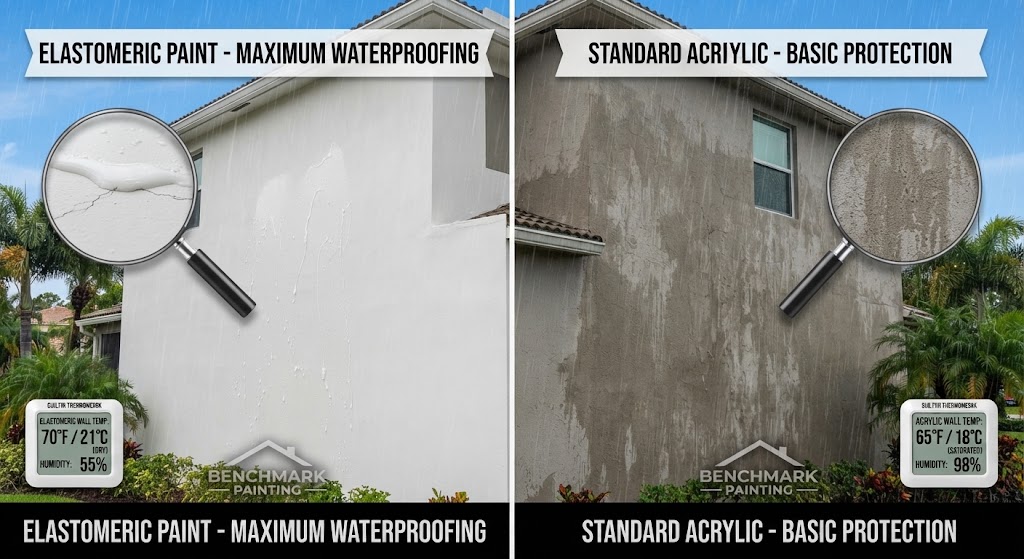
Standing in the paint aisle deciding between elastomeric and standard acrylic isn’t just a color decision; it’s a decision about how well your exterior walls will actually keep water out for the next several years. For stucco homes especially, that choice matters more than most homeowners realize, since stucco’s porous, crack-prone nature makes it far more dependent on the right coating than smoother siding materials.
At Benchmark Painting, we field this question constantly from homeowners preparing for an exterior repaint. Here’s a clear, honest breakdown of how these two coating types actually compare, so you can choose based on your home’s real needs rather than whichever product happens to be on sale.
The Quick Comparison
| Elastomeric Paint | Standard Acrylic Paint | |
| Elasticity | Highly flexible, stretches and contracts with the surface | Minimal flexibility, more rigid film |
| Waterproofing ability | Excellent; bridges hairline cracks and blocks water intrusion | Good, but limited crack-bridging capability |
| Best suited for | Stucco, especially homes with existing hairline cracking | Smooth siding, wood, or well-maintained stucco with minimal cracking |
| Coating thickness | Thicker application, typically 10-20 mils | Thinner application, typically 2-4 mils |
| Breathability | Good, but varies by product; check specs for humid climates | Generally good breathability |
| Cost | Higher upfront cost | Lower upfront cost |
| Typical lifespan | 10+ years in most conditions | 5-7 years in most conditions |
| Application complexity | Requires proper surface prep and experienced application | More straightforward application |
What Makes Elastomeric Paint Different
Elastomeric paint isn’t really “paint” in the traditional sense; it’s closer to a flexible waterproof membrane that happens to come in color. Its defining characteristic is elasticity: a properly applied elastomeric coating can stretch significantly and return to its original shape, which means it moves with a building’s natural expansion and contraction rather than cracking under the stress.
This matters enormously for stucco, which is prone to developing hairline cracks as a building settles and shifts with temperature changes. A standard paint film sitting over those cracks simply telegraphs them; the crack remains a path for water intrusion regardless of the paint on top. Elastomeric coatings, applied at proper thickness, can actually bridge those hairline cracks, creating a continuous waterproof barrier rather than a colored layer over an existing vulnerability.
What Makes Standard Acrylic Paint Different
Standard acrylic paint is a more traditional, thinner coating that provides solid protection against sun, moisture, and general wear but without the crack-bridging capability that defines elastomeric products. It’s a well-established, reliable choice for surfaces that aren’t prone to significant cracking, and it’s generally easier and faster to apply.
Standard acrylic tends to be the right call when:
- The surface is smooth siding or wood rather than stucco
- An existing stucco surface is in excellent condition with no notable cracking
- The homeowner is prioritizing a lower upfront cost and a shorter-term repaint cycle
- The building has minimal structural movement or settling history
When Elastomeric Paint Is the Clear Choice
Elastomeric coatings tend to outperform standard acrylic specifically when:
- The home has stucco exterior walls, particularly with any visible hairline cracking
- The property has a history of water intrusion or staining that suggests the current coating isn’t fully sealing the surface
- The building has experienced any settling or movement, which increases the likelihood of ongoing hairline cracks over time
- Long-term value matters more than upfront cost, since elastomeric’s longer lifespan often offsets its higher initial price over a decade-plus timeline
A Few Things to Know Before Choosing Elastomeric
Elastomeric paint isn’t automatically the right choice for every situation, and applying it incorrectly can actually cause problems rather than solve them:
- Proper surface prep is essential. Elastomeric coatings need a clean, properly prepared surface to bond correctly. Applying it over existing failed paint, dirt, or mildew will undermine its performance regardless of product quality.
- Thickness matters. Elastomeric coatings need to be applied at a specific mil thickness to achieve their crack-bridging properties. Too thin, and you lose much of the waterproofing benefit; this is a common mistake with inexperienced application.
- Breathability varies by product. In a humid climate, trapped moisture behind a coating can cause its own problems, so choosing a product with adequate breathability (and confirming existing wall moisture levels before application) is an important step our team evaluates before recommending a coating system.
Which Should You Choose for Your Home?
If you’re dealing with stucco, especially stucco showing any hairline cracking or a history of moisture issues, elastomeric paint is generally the stronger long-term investment, despite the higher upfront cost. If your exterior is smooth siding in good condition without cracking concerns, standard acrylic remains a solid, more budget-friendly option.
The honest answer is that the right choice depends on your specific surface, its condition, and your home’s history, which is exactly why a proper on-site assessment matters more than a generic recommendation. Our exterior painting team evaluates your walls’ actual condition, including existing cracking and moisture history, before recommending elastomeric, standard acrylic, or a hybrid approach tailored to your home.
Get an Expert Recommendation for Your Home
Choosing between elastomeric and standard acrylic isn’t a decision to make based on price alone; the wrong choice can mean a repaint that fails to actually solve your water intrusion problem, or paying for waterproofing capability your walls don’t really need.
As trusted painters in Delray Beach and throughout the surrounding area, Benchmark Painting can assess your exterior walls in person and recommend the coating system that actually fits your home’s condition and climate exposure. Contact us today for a free consultation, and let’s get your exterior properly waterproofed, the first time.
